
Clark County Sex Offenders Overview
Clark County sex offenders are managed through a countywide system that combines sheriff registration work, Vancouver Police monitoring, and statewide disclosure rules. The sheriff's office is the lead agency for compiling and maintaining offender information in the county, while Vancouver Police focuses on city monitoring, investigations, and community forums. If you need a practical starting point, the county sheriff page explains how risk levels shape notification, the city page explains how offenders are tracked in Vancouver, and statewide resources like WASPC and NSOPW help fill in the gaps. The result is a public safety system built around relevant information rather than speculation.
Clark County Sex Offenders at a Glance
Clark County uses risk level, location, and community need to determine what information is released and how it is shared. That approach is rooted in the Community Protection Act of 1990 and the county sheriff's role as the local lead for sex and kidnap offender information. Vancouver Police adds a city-level monitoring layer for offenders living in the city, while the state registry and national registry provide the public-facing search tools that many people start with.
| County SOR questions | SOR Detectives at 564-397-2284 or clarkcountysor@clark.wa.gov. |
|---|---|
| County sheriff role | Lead agency for compiling and maintaining offender information in Clark County. |
| Vancouver unit | Sex Offender Notification Apprehension and Registration Unit, created in 2003. |
| Statewide search tools | WASPC and the National Sex Offender Public Website. |
| Level assignment | Static 99 assessment used by detectives to assign risk levels. |
Those points are useful because Clark County treats sex offender information as a layered process. You may start with the sheriff's office, but the answer may also depend on whether the person lives in Vancouver, is transient, or is under Department of Corrections supervision.
Clark County Sex Offenders and the Sheriff's Role
The Clark County Sheriff's Office says it is the lead agency for compiling and maintaining offender information under the Community Protection Act of 1990. The county also explains that the office releases information that is relevant and necessary to protect the public and counteract the danger created by a particular offender, in line with RCW 4.24.550. The extent of disclosure is tied to the risk posed by the offender, the offender's location, and the needs of affected community members. That is a narrower standard than a general curiosity search.
The county sheriff's materials also note that Washington courts and the legislature have shaped the dissemination rules, including the guidance from RCW 4.24.550 and the standards discussed in State v. Ward. Clark County detectives use the state-approved Static 99 assessment to assign levels, which keeps the county process aligned with statewide risk classification. The sheriff homepage adds broader context: the office was established in 1849, is the oldest law enforcement agency in Washington, and says its mission is to protect and safeguard the community while making Clark County as safe and livable as possible.
That mission statement is not just branding. It explains why the county stresses that the informed public is a safer public and that notification is not intended to increase fear. The sheriff's office says the point is to provide relevant and necessary information, not to create a campaign of public harassment against the offender or the offender's family.
Clark County Sex Offenders and County-Level Records
The Clark County Sheriff's Office sex and kidnap offender registration page publishes the county overview that anchors the local registration system and explains disclosure limits, risk factors, and the contact point for registration questions.
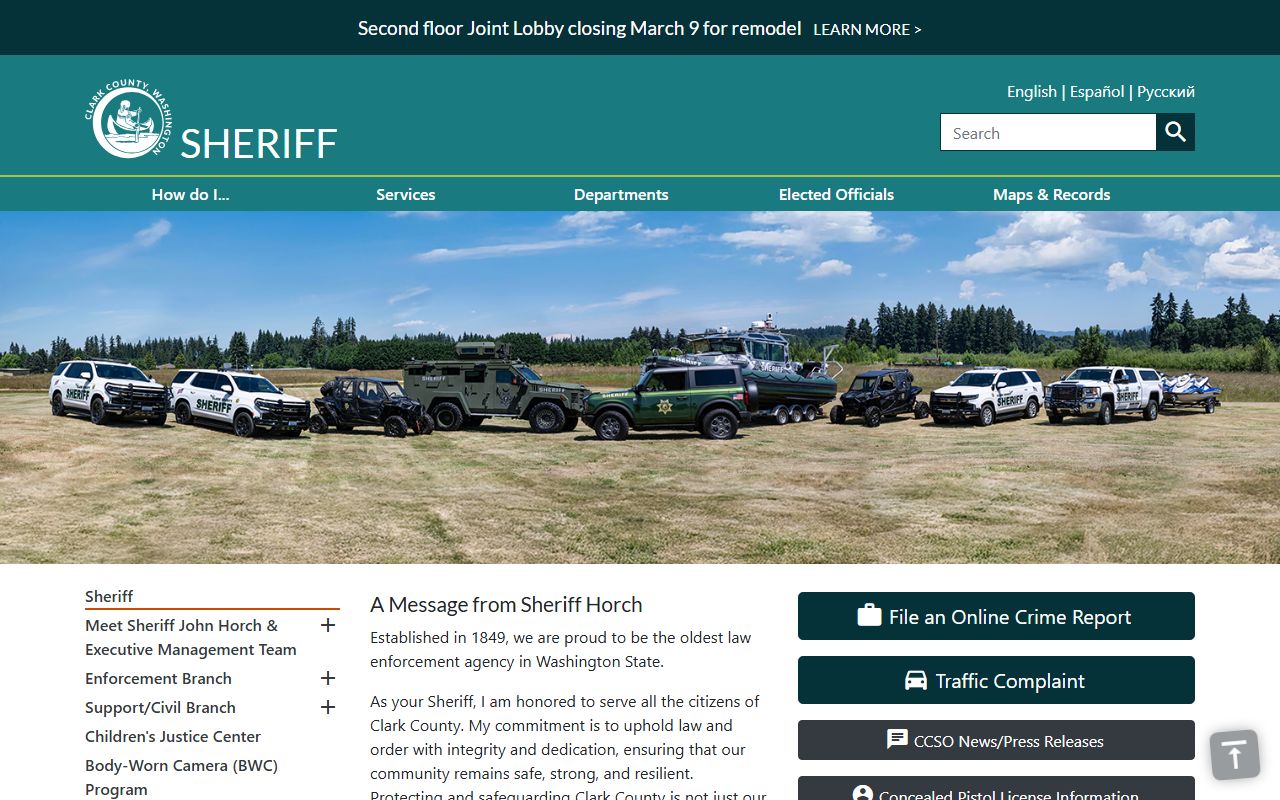
That county page is where the public can see the sheriff's role described in one place, including the warning that threats, intimidation, or harassment are not tolerated.
How Vancouver Handles Sex Offenders in Clark County
The Vancouver Police Department's Sex Offender Unit was created in 2003 to better monitor registered offenders within the city. The unit handles registration, tracking, investigations, and community forums for neighborhood associations, community groups, local schools, and the general public. That city-level role matters because Clark County is large, and a resident may interact with both city police and the county sheriff depending on where the offender lives.
The Vancouver page also explains the partnership with the Washington State Department of Corrections. DOC probation officers may accompany law enforcement during home contacts for offenders on active probation, and DOC may impose restrictions on where supervised offenders can live, go, or have contact. The city makes a separate point that it has no legal authority to direct where offenders may or may not live unless court-ordered restrictions exist. That lines up with the state rule that residence decisions are limited by law only when a court or supervision condition says otherwise.
Vancouver Police further notes that the Clark County Sheriff's Office maintains records for all offenders in the county, including those living in Vancouver, and also tracks transient offenders who claim no permanent residence. That is important in a county where people often expect a fixed address when the reality may be more fluid.
The city resource below shows how that local monitoring is presented to the public. It is especially useful if your question involves a Vancouver address, a community forum, or a probation contact that crosses between city and county agencies.
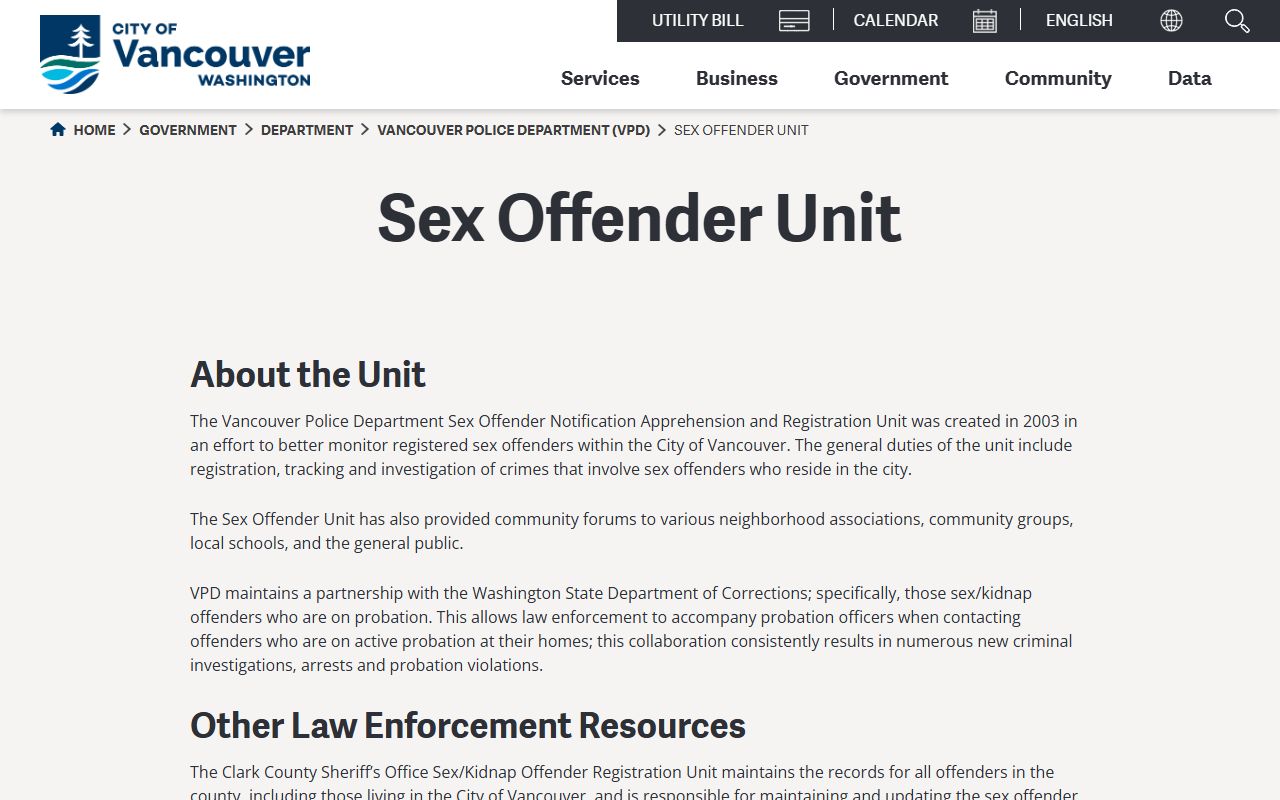
The Vancouver Police Department page helps explain why local monitoring in Clark County is a city-county partnership rather than a single-office process.
Clark County Sex Offenders, Public Notice, and Community Safety
Community notice in Clark County is driven by the offender's level and the community's need for information. The sheriff page says disclosure is based on what is relevant and necessary, and that the standards are restricted by the legislature and by Washington Supreme Court precedent. It also says the purpose of the Community Protection Act is to help law enforcement protect communities by sharing accurate information, not to encourage fear. That distinction is why the county repeatedly warns against using registry data to threaten or harass anyone.
When the county says an informed public is a safer public, it is also describing the practical limit of disclosure. The information released should relate to the offender's risk, the offender's residence or work area, and the information needed by the community. That is why the sheriff's office tells questions to go to the SOR Detectives at 564-397-2284 or clarkcountysor@clark.wa.gov. It is the county contact most closely tied to the registration record itself.
The official county sex and kidnap offender page reflects the county's approach to notification, the use of the Static 99 assessment, and the warning that misuse of public information can undermine the notification system.
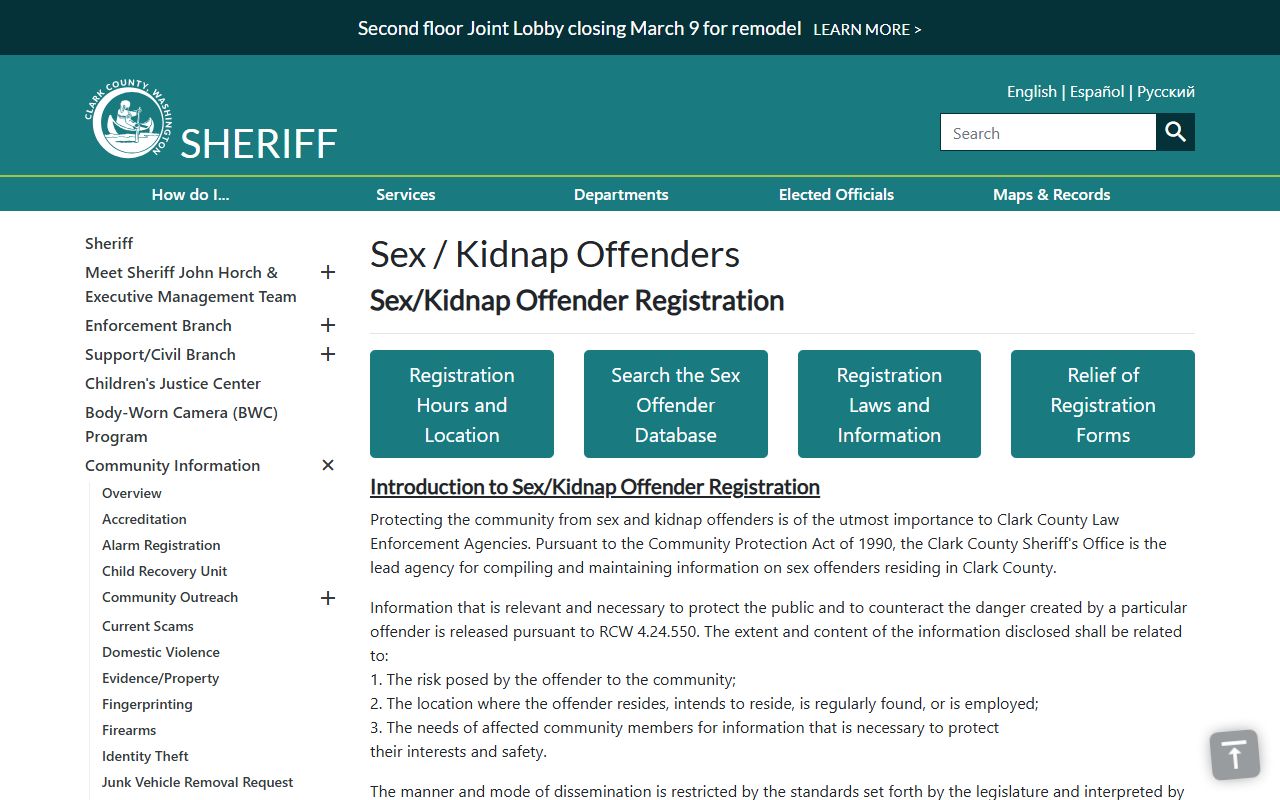
That page is the most direct county summary for people who want the sheriff's own explanation of how Clark County manages public safety disclosure.
Statewide Tools for Sex Offenders
Clark County residents often need statewide context after they review the county page. WASPC explains that the Washington Sex Offender Public Registry is available at waspc.org/sex-offender-information, while the national search tool is the Dru Sjodin National Sex Offender Public Website. Together those tools let people search by name or location across state lines. That is especially useful when a person has moved, has ties outside Washington, or appears in a national search but not in a county search.
The WASPC guidance also helps interpret what Clark County publishes. Level I offenders are not published unless they are transient or out of compliance, while Level II and Level III offenders are published on the public registry. Communities are notified when a Level II or Level III offender registers a new address, and email alerts can be set for a location within one mile of an address you choose. If community members think notification has not reached everyone who should know, they may copy and distribute the flyer within reason and contact local law enforcement for more direction.
That statewide structure ties back to the county's own warning that harassment is not tolerated. The public is supposed to use the information to stay informed and protect themselves, not to escalate conflict or interfere with lawful notification.